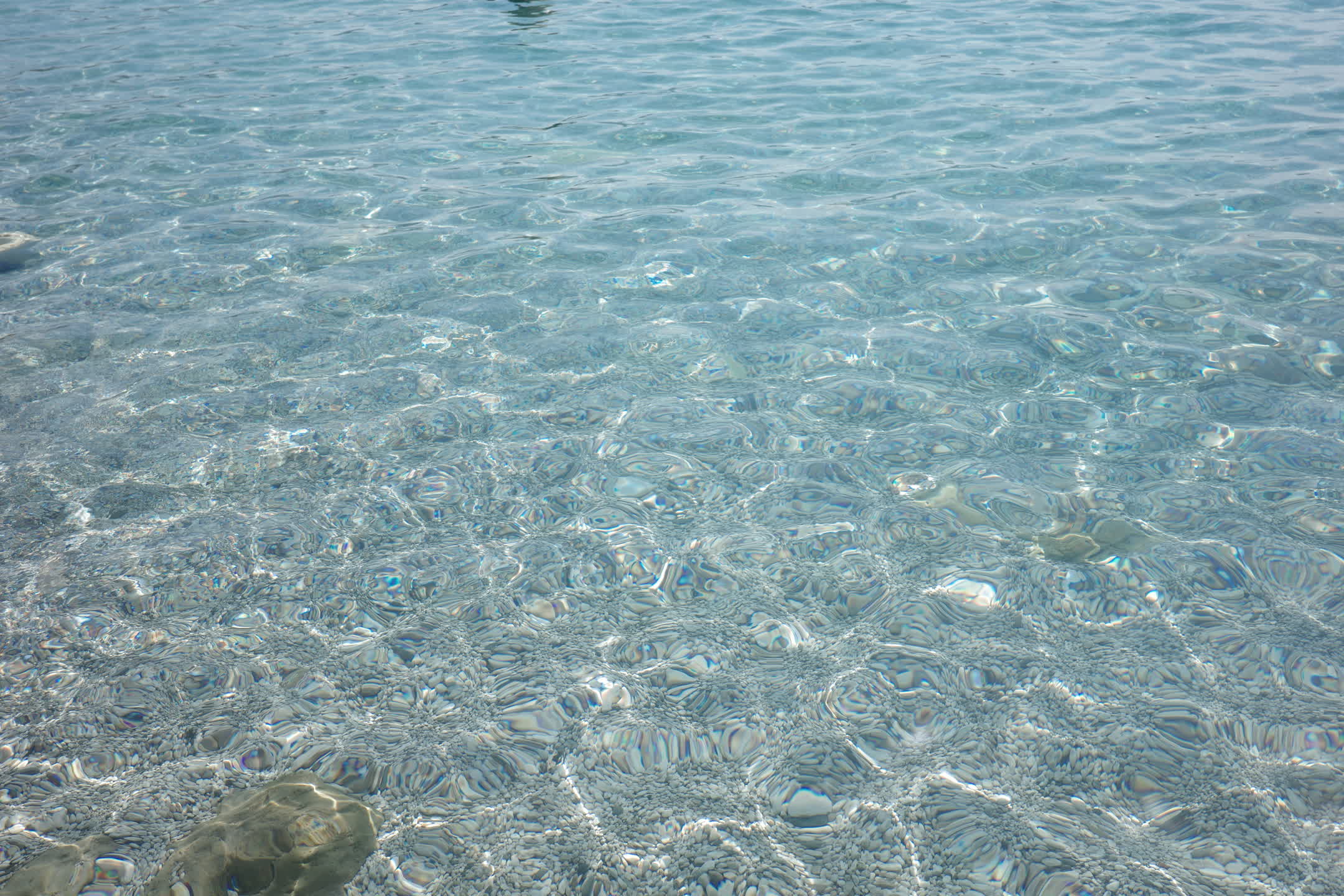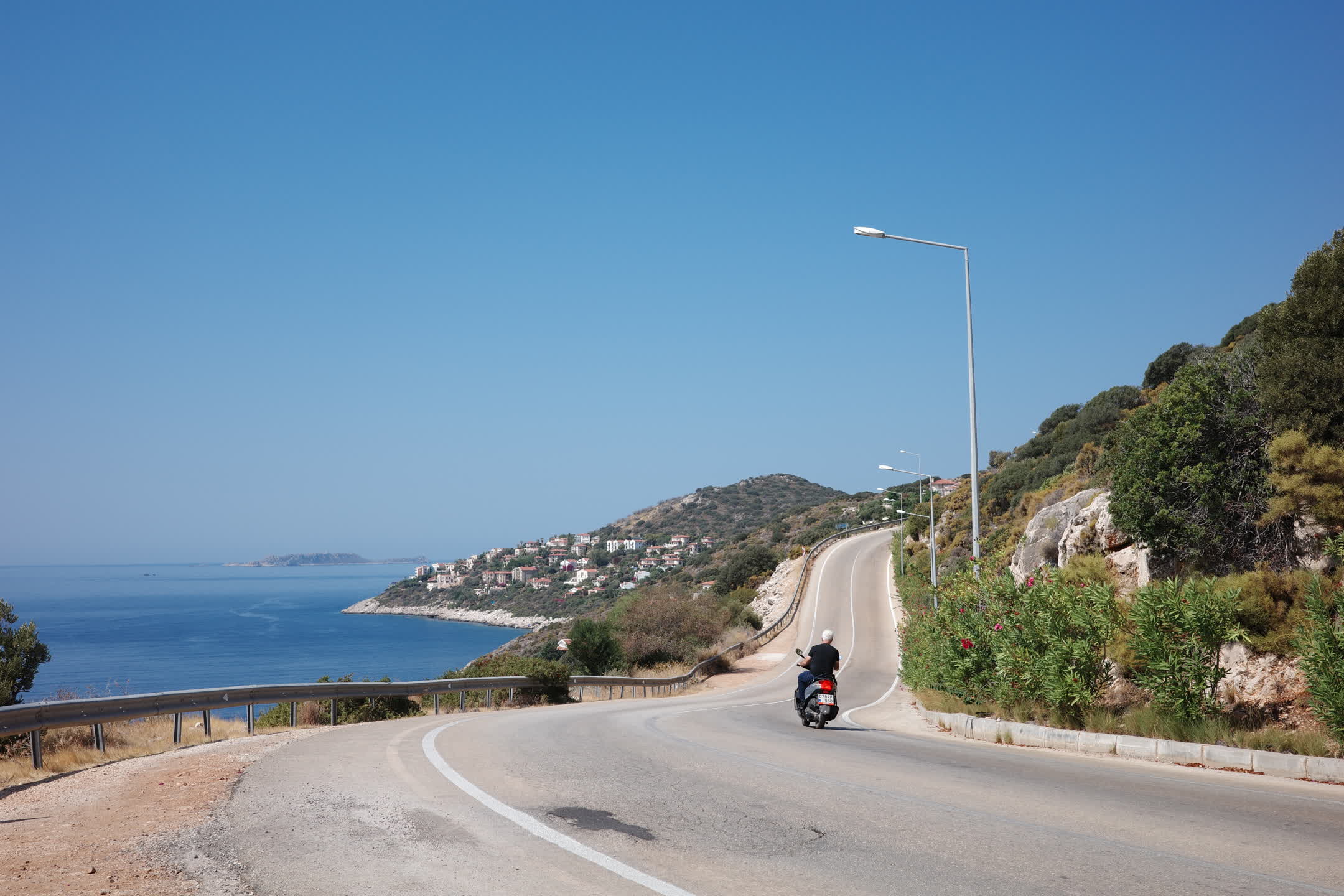
On the west side of Kaş lies a peninsula, shaped like a piece of dough squeezed out by hand—narrow at the tip and wide at the base. Heading north from the busy town center and turning past a fork in the road, you reach its entrance. A large ring road encircles the entire peninsula. Just follow it forward—no guidance needed, few cars, excellent road conditions.
The sunlight was brilliant. Even with sunglasses on, which cast the mountains and sea under a dark translucent filter, everything still lay completely exposed under the fierce shine. I rode the little scooter we rented yesterday, cruising along the road. Pink flowers appeared now and then by the roadside, their color popping vividly against the gray-yellow vegetation. To the left were mountains—hotels and apartments nestled near the foothills. To the right, the sea—crowded beaches, umbrellas, people. The road ahead was playful, curving, weaving, at times neatly hidden behind the hills.
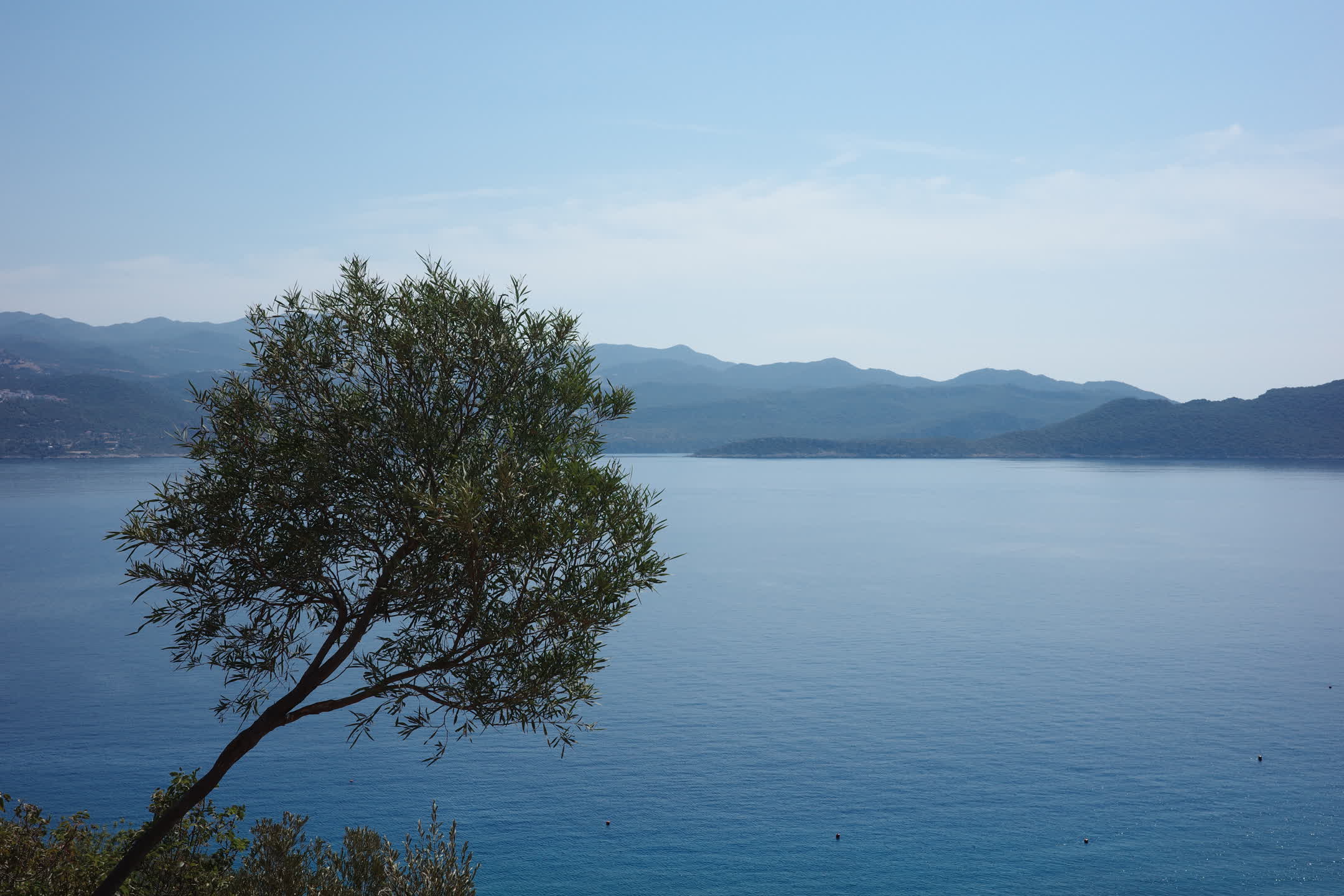
Pictures show scenery more clearly than words, but the feeling of speeding between mountain and sea on a scooter—that can’t be captured by a camera.
Left hand resting lightly on the brake, right hand gently twisting the throttle, my eyes darted between the road ahead and the speedometer. The speed hovered between 30 and 40, rising and falling with each little flick of my wrist. The engine roared, a noise I gradually adapted to—only when I stopped to rest, when all sound suddenly emptied out, did I realize how loud it had been. Wind was another indicator: when it rushed past sharply and recklessly, it hinted that speed was climbing. When wind faded from my skin and sunlight scattered on me again, the speed slowed—until it stilled completely.
Whenever I saw a good view, I’d find a safe spot, park, and turn off the engine. The earlier wild growl instantly became obedient. If I listened carefully, the exhaust pipe at the back still trembled faintly—unclear whether it was a mechanical issue or just physics. Facing the sea, I took a few photos. Turning around, I saw the scooter standing alone by the roadside—no cars, no people—like I was stranded in the wilderness. For a moment, a faint panic rose: what if the scooter broke down, leaving me abandoned under the scorching sun? My mind wandered—imagining myself as a lone highway wanderer, carrying full repair gear and mastering not systematic but highly practical repair skills. Even if my trusty companion malfunctioned, I could fix it myself—clank, bang, done. After several attempts at restarting the engine, the roar returned, and the journey continued.
There was another peculiar sensation. My lower body sat firmly on the seat, feet planted securely—yet my head and upper body felt the rush of fast, cutting wind, as if they were sprinting forward with superhuman speed. It was strange—my upper and lower halves sensing different velocities. This odd mismatch repeatedly poked at my nerves; whenever my grip loosened even a little, it reminded me, correcting my posture.
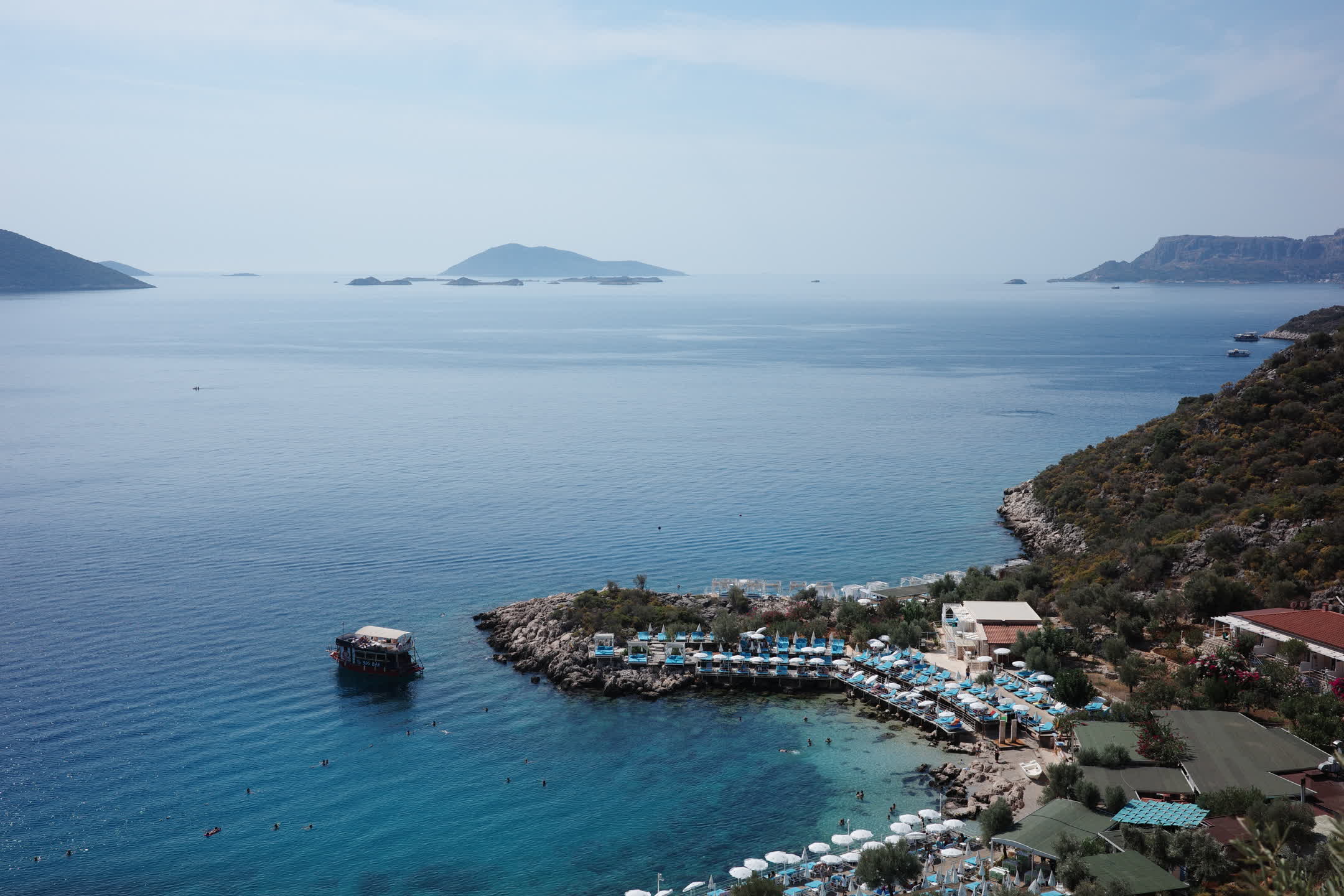
Even under the sea breeze, I couldn’t escape the sun’s burn. Most vegetation was low, hugging the mountain slopes. There were a few scattered trees by the road, barely taller than a person, but their shade couldn’t be called shelter. The land was mostly barren and flat. To stand there and overlook the sea and islands, you had to expose yourself fully to the sky, confronting the sun head-on. I endured for a while, taking photos here and there—but soon sweat wouldn’t stop flowing, and my skin stung sharply as if protesting. So I had to end my loop around the peninsula sooner than planned, fleeing toward the beach to seek the sea’s comfort.